The fomo Leaderboard: How the Ranking Works, and Why You Cannot See It From a Browser
Table of Contents
- What the leaderboard is
- What it ranks by, and what fomo will not say
- The timeframe tabs, and why fomo's pages disagree
- What "verified on-chain" does and does not cover
- There is no leaderboard web page, and that is deliberate
- Clans, and what we are not claiming
- How to read a leaderboard number without fooling yourself
- Related reading
 fomo puts a ranking of its most profitable traders inside the app, and that ranking is doing a lot of work. It is what turns a trading app into a social one, it is what people screenshot, and in the first week of September 2026 it produced a run of crypto press about a single trader whose reported balance moved faster than the outlets could publish.
Almost none of what gets written about that ranking explains how it is built. This page does. Two terms first, because everything below depends on them. PnL is short for profit and loss, the number an app shows for how much you are up or down. Realized PnL is money you have actually taken out of a position by selling. Unrealized PnL is what your holdings would be worth if you sold right now, at today's price, and it is not money until you do.
fomo ranks traders by profit and says the underlying trade data is verified on-chain. It does not publish a methodology page, does not state whether the ranked profit is realized or unrealized, and its own four help pages disagree about which time periods the board covers. There is also no public web page for the leaderboard or for any trader's profile. fomo's robots file blocks profile paths from search engines and the addresses render an empty shell, so the app is the only place the ranking exists.
What the leaderboard is
It is a list of fomo users ordered by how much profit their trading has produced, viewable in the app and refreshed continuously. You can open it, see who is at the top, tap through to a trader, and follow them so their buys and sells appear in your feed.
That last step is the point of the whole feature. fomo's product is a social feed of other people's trades, and the leaderboard is the discovery layer that fills it. Without a ranking you would have to already know whose trades you wanted to watch.
The trades behind it settle on public blockchains,  Solana and
  Robinhood Chain among the six fomo supports, which matters later in this article for what anyone outside fomo can reconstruct.
What it ranks by, and what fomo will not say
fomo's help page on crypto trading leaderboards, checked September 6, 2026, names four things a leaderboard can rank on: total profit and loss, win rate, return on investment, and volume. It calls Total P&L "the most common ranking metric."
Read that page closely before treating it as a specification. The sentence describes crypto leaderboards as a category, not fomo's board in particular. fomo has no page anywhere that says "our leaderboard sorts on X." So the honest statement is that profit is the headline metric, on fomo's own framing, and the exact formula is undocumented.
The gap that matters more is the one in the middle of that metric.
fomo does not say whether the ranked profit is realized or unrealized
We read fomo's leaderboard explainer, its page on finding profitable traders, its page on buying crypto by following top traders, and its blog guide to the social features, all on September 6, 2026. None of them states whether the profit driving the ranking is money the trader has taken or the paper value of what they still hold. This is an absence, not a contradiction, and it is the single most useful thing to know about any number you see on that board.
Outside analysts who have gone through the top of the board describe those positions as still open. MarsBit's study of the top 20 profit leaders, relayed through Foresight News and mirrored by KuCoin on September 4, 2026, states that "most large positions on the leaderboard still include unrealized gains and have not been fully cashed out." ChainCatcher's newsflashes about the trader in first place use the word unrealized throughout.
So the working assumption, until fomo documents otherwise, is that a big leaderboard number is a paper valuation of tokens the trader is still holding. That is not a criticism of the figure. It is a different quantity from cash, and the difference gets larger the thinner the token's market is.
The timeframe tabs, and why fomo's pages disagree
Four fomo-owned pages describe the same feature and do not match. All checked September 6, 2026.
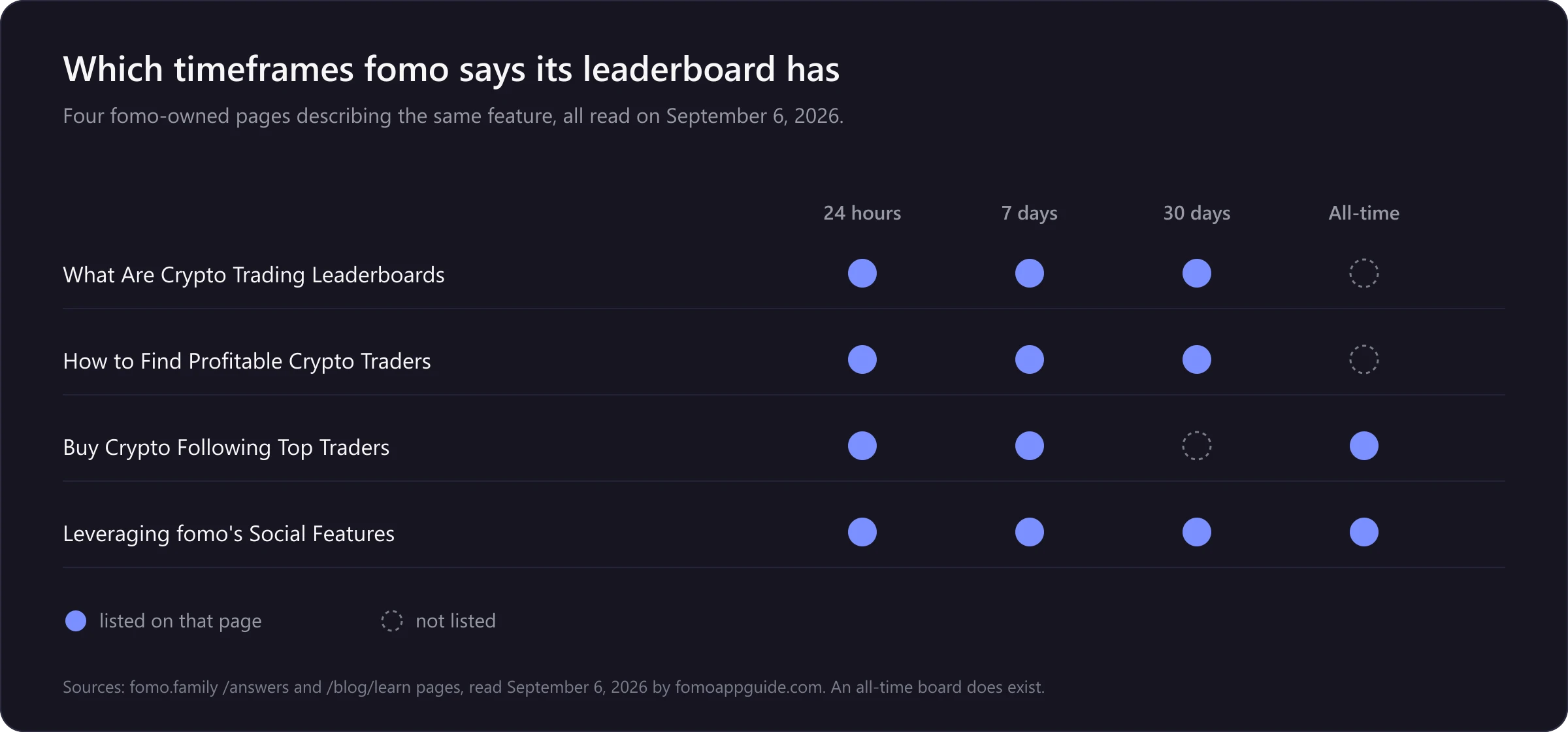
Built from fomo's own pages, read September 6, 2026
The exact wording, page by page:
| fomo page | Timeframes it lists | All-time? |
|---|---|---|
| What Are Crypto Trading Leaderboards | "24-hour, 7-day, and 30-day periods" | No |
| How to Find Profitable Crypto Traders | "24-hour, 7-day, and 30-day periods to distinguish streaks from skill" | No |
| Buy Crypto Following Top Traders | "daily, weekly, and all-time timeframes" | Yes |
| Leveraging fomo's Social Features | "24h, 7D, 30D, All-time" | Yes |
An all-time ranking does exist. The trader currently at the top posts his all-time position on X, and has done since July. So the two pages that stop at 30 days look stale rather than wrong, and the blog guide listing all four tabs is the one to trust.
The distinction matters practically, not pedantically. A 24-hour board and an all-time board are answering completely different questions. The first tells you who had a good day, which on a memecoin can mean one position that happened to move. The second tells you who has accumulated profit over their whole history on the app. fomo's own help page makes the point in passing when it recommends browsing multiple periods "to distinguish streaks from skill."
What "verified on-chain" does and does not cover
fomo makes the same claim on two pages, both checked September 6, 2026:
All trading data is verified on-chain, so the rankings reflect actual performance.
and
Verified on-chain data - Every trade is recorded on-chain. You're seeing real performance.
Take that at face value and it still leaves questions open, because on-chain settlement and a leaderboard formula are separate things. A trade being recorded on a blockchain means the transaction happened and anybody can look it up. It does not tell you which wallets fomo attributes to a given account, whether trades a user made somewhere other than fomo are counted, how a position's current value is priced when the token barely trades, or whether the ranking counts profit taken or profit on paper.
None of that is documented. We found no source alleging fomo's numbers are false, and we are not suggesting one. The point is narrower: an on-chain claim answers "did this trade happen," and the questions people actually have about a leaderboard are mostly about what happens after that.
Want to see the board yourself?
Sign up through our link and the 10% referral fee discount applies at signup, per fomo's help center. It cannot be added afterwards.
Get the fomo appThere is no leaderboard web page, and that is deliberate
This one surprised us, so we checked it three ways on September 6, 2026.
The robots file blocks profiles
fomo.family/robots.txt allows crawling broadly, then names specific paths that search engines must skip. Three of them are /profile/, /user and /u/. Those are the addresses a trader's page would live at, and fomo is telling Google to stay away from all of them.
The sitemap has no leaderboard in it
fomo's sitemap lists 156 pages: marketing, about 72 help answers, the blog, 52 learn articles, a clans page, prices and affiliates. There is no /leaderboard entry, and no profile addresses of any kind.
The addresses render nothing
Loading fomo.family/profile/RugDalio or fomo.family/u/theunipcs returns a page shell with the site's generic title and no content. No handle, no PnL, no holdings, not even a description. The app builds those screens after loading, so a browser or a crawler arriving cold sees an empty page.
The consequence for readers is simple and slightly annoying. You cannot send someone a link to the fomo leaderboard, because there isn't one. You cannot link a trader's profile either. Every screenshot you have seen in a news story came out of somebody's phone.
It also explains a shape you may have noticed in the coverage. Stories about fomo's top traders cite a trader's own X posts, or an analytics firm's read of their wallet, or another outlet. They cite fomo itself for the ranking almost never, because there is nothing to cite.
Third parties mirror the data, with strings attached
Because the trades settle on public blockchains, anyone can rebuild the rankings from chain data without fomo's involvement, and at least one site does. peer.family publishes crawlable trader pages with profit, follower counts and trade history, and says traders are "listed permissionlessly from public on-chain activity" and that it is "not affiliated with fomo.family or Robinhood Markets." We are naming it as evidence that the data is reconstructable, not sending you there: alongside the stats it sells options and prediction markets on whether a given trader will be up over the next 24 hours or 7 days, which is a product with its own risks. A second site, fomotop.money, is sometimes mistaken for the official board and says plainly on its own page that "nobody's PnL is shown here, and this is not the FOMO app's leaderboard."
Clans, and what we are not claiming
Clans are fomo's group accounts. Several traders join one, the group's combined performance is tracked, and clans get ranked against each other weekly.
Where it gets murky is whether that ranking sits on the same board as individual traders. A fomo newsletter described clans ranking on a weekly leaderboard alongside individuals. Odaily's guide from September 1, 2026 describes a separate list ranked by "the team's overall profitability," and recommends checking the 7-day and 30-day standings because "some teams may only be carried by one or two large positions, or even a single lucky trade." fomo's own X account posts weekly clan standings as their own top five. The fomo.family/clans page exists and carries a heading with no rankings under it.
Two boards or one, the warning in that Odaily line is the useful part, and it applies to individuals just as well. A weekly ranking rewards whoever held the right thing that week.
How to read a leaderboard number without fooling yourself
Check which tab you are looking at. A 24-hour ranking and an all-time ranking will show you different people, and only one of them is a track record.
Assume the profit is on paper until you know otherwise. fomo does not label it, and analysts who have checked describe the big positions as still open. Paper gains in a token that trades thinly can move a long way in a day, in either direction.
Ask what the position is worth on the way out. A holding is only worth its screen value if there is someone to sell it to at that price. For a token that launched a few weeks ago, there may not be.
Look at what a trader survived, not just what they made. A ranking shows the current standing. It does not show the drawdowns, and the same person can appear on both sides of that over a single quarter.
Remember the fee is the same either way. A trade you place because the leaderboard pointed you at it costs exactly what any other trade costs. Our fees guide works the numbers in dollars, and on small orders they are larger than most people expect.
Get the documented discount before you sign up
10% off trading fees, 0.50% down to 0.45%, straight out of fomo's own help center. It only applies if the link is opened before the account exists.
Get 10% off fomo feesRelated reading
- Who Are the Top Traders on fomo?: the names at the top of the board, and how fast the numbers attached to them move
- Following fomo's Top Traders: What the Data Says: the share of fomo wallets that actually finished ahead, and the mechanism behind it
- fomo's Social Feed and What Copy Trading Means: why nothing gets mirrored into your account automatically
- fomo Fees Explained: the full schedule, including the Solana size bands
- What Is fomo?: the app, the company and the funding behind it
Frequently Asked Questions
No. We checked on September 6, 2026. fomo's robots.txt tells search engines not to crawl /profile/, /user or /u/, its sitemap lists 156 pages with no leaderboard or profile URLs among them, and loading a profile address such as fomo.family/profile/RugDalio returns an empty page shell with the site's generic title and nothing else. The rankings live inside the mobile app. If you want to see them, that is the only place.
Profit, according to fomo. Its help page on crypto trading leaderboards lists total profit and loss, win rate, return on investment and volume as the criteria a leaderboard can use, and calls total profit and loss the most common one. That sentence is written about crypto leaderboards in general rather than about fomo's own board specifically, and fomo publishes no methodology page for its ranking. Checked September 6, 2026.
fomo does not say, anywhere we could find on September 6, 2026. That matters, because realized profit is money you have actually taken, and unrealized profit is what your holdings are worth on paper right now. Outside analysts who have looked at the top of the board describe the large positions as unrealized and not cashed out. Until fomo documents it, treat a leaderboard number as a paper valuation.
Four fomo-owned pages give two different answers. Two of them list 24 hours, 7 days and 30 days. The other two add an all-time ranking. An all-time board does exist, because the trader at the top of it posts his all-time position on X. So the pages listing only three periods appear to be out of date rather than wrong about the product. All four checked September 6, 2026.
Unclear, and we are not going to guess. A fomo newsletter described Clans ranking on a weekly leaderboard alongside individuals. Coverage from Odaily describes a separate board ranked by each team's overall profitability, and fomo's own X account posts weekly clan standings as their own list. The fomo.family/clans page carries a heading and no rankings. Confirming this needs someone with the app open.
FomoAppGuide is an independent, unofficial resource. It is not affiliated with, produced by, reviewed by, endorsed by, or sponsored by FOMO Labs, Inc., the company behind the fomo app. "fomo" and all related names, logos, and marks belong to their respective owners and are used here only to identify and comment on the products this site covers. For anything official, go to fomo.family. Full disclaimer.
Disclaimer: Nothing here is legal, tax, financial, or investment advice, and none of it is a recommendation to trade. Trading crypto carries real risk of total loss. Whether a product is lawful, how a trade is taxed, and what is available where all vary by jurisdiction and change over time. Check the primary sources, read the platform's own terms, and speak to a qualified professional before acting on anything you read on this site. Trading memecoins in particular involves substantial risk of loss, and most of them go to zero. Past performance is not indicative of future results. This site contains referral links: signing up through our referral link earns us a share of the trading fee you pay, at no extra cost to you, and gives you a permanent 10% discount on your own trading fee.
Ready to Start Trading?
Sign up to fomo through our link and your trading fee is permanently 0.45% instead of 0.50%.
Get 10% off fomo fees