Following fomo's Top Traders: What the Data Says About How It Goes
Table of Contents
 The appeal of a trading app built around a leaderboard is obvious and it is not stupid. Someone visibly good at this is showing you their trades in real time. Why would you not watch?
Watching is fine. The question worth answering before you act on what you see is how it has gone for everyone else who did, and for once there is a number.
DWF Ventures published research in late August 2026 examining roughly 292,000 fomo wallets. About 6.16% were profitable over 90 days measured on realized gains, and 25 wallets in the whole set cleared $10,000 in net realized profit. DWF's explanation is structural rather than a comment on anyone's ability: followers buy after the trade is visible, which moves the price in the original trader's favor, and they are still holding when that trader sells.
The number, and where it comes from
DWF Ventures published the study around August 28, 2026. It was picked up by Yellow and AlexaBlockchain, among others. The headline findings:
- Roughly 292,000 fomo wallets examined.
- About 6.16% were profitable over 90 days, measured on realized gains, meaning money actually taken rather than positions still open.
- 25 wallets cleared $10,000 in net realized profit.
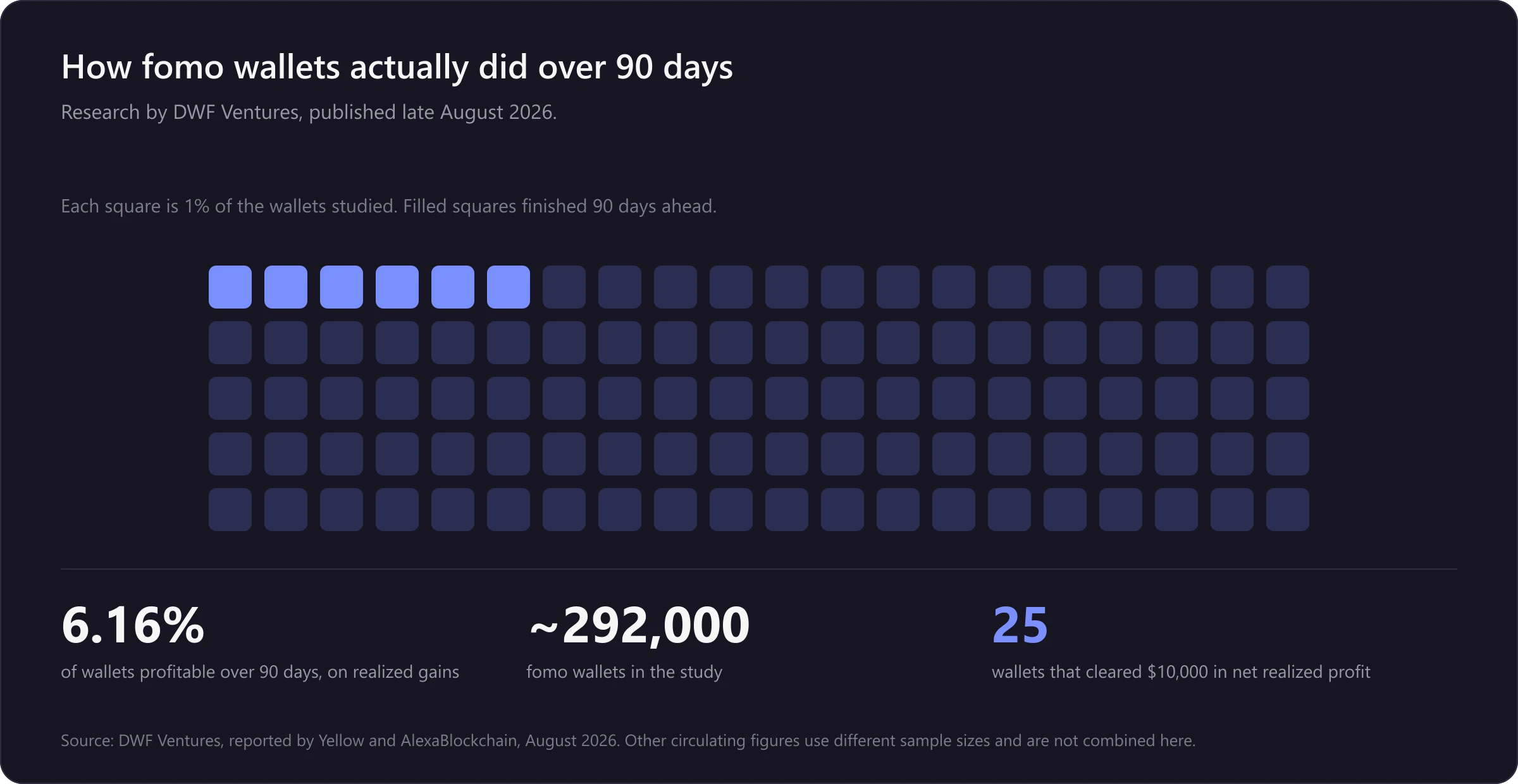
Built from the DWF Ventures figures as reported in August 2026
That last figure is the one that reframes the first. Six percent sounds survivable. Twenty five wallets out of nearly three hundred thousand clearing five figures is a different shape of outcome entirely, and it says the profits are not spread thinly across a lucky tenth of users. They are concentrated in a handful of accounts.
Other versions of this statistic are floating around, and they disagree
An opinion column at news.bitcoin.com on September 6, 2026 cites 429,000 traders with roughly 5% in profit and 0.25% above $500. A third variant, quoting 500,000 traders and 226 accounts above $10,000, shows up in search summaries with no traceable original. These are not the same study and averaging them would be inventing a number. We quote the DWF figures because the sample size, the window and the realized-gains basis are all stated. Treat the others as unconfirmed until someone publishes the method behind them.
Two things this research does not say, before anyone stretches it. It does not say fomo is doing anything improper, and it does not say fomo is worse than its competitors, because it did not measure any of them. What DWF contributes is a count of one platform's wallets and a mechanism specific to how a public trading feed works.
Why the order of operations matters more than the pick
DWF's account of it is about sequence. Walk through what happens when a trader with a large public following buys something.
The trader buys first
They take their position at whatever the market price is before anyone knows about it. On a token with a small market, that price is the cheapest one anybody in this story will get.
The trade appears in the feed
It settles on-chain, gets indexed, and shows up for every account following that trader at roughly the same moment. Nobody following is early. Everybody following is simultaneous.
Followers buy, and their buying moves the price
In DWF's framing this is the part that makes the original position work. The follower demand arriving after the entry pushes the price up, and the person it benefits most is the one who was already in.
The trader sells into that demand
DWF puts it directly: followers absorb the drop when the caller sells. Somebody has to be holding on the way down, and the people who bought after the feed post are the people available to do it.
DWF raises one further point that is harder to check: a trader can run a second wallet that accumulates a position before the public wallet attached to their social identity buys it. DWF describes this as something the structure permits, not as an accusation against any named account, and neither are we. It is a reason to treat a public trading identity as a marketing surface as well as a track record.
The trader currently at the top of fomo's board has publicly engaged with a related criticism, that tokens he holds rise partly because his followers buy behind him, and has said he now waits until a position has appreciated before naming the ticker. Whatever you make of that as a remedy, it is an acknowledgment that the mechanism is real.
If you are signing up regardless
Our link applies fomo's documented 10% referral discount at signup, taking 0.50% to 0.45%. It cannot be added to an existing account.
Get the fomo appA leaderboard is a list of survivors
Set the mechanism aside for a moment, because there is a second problem baked into rankings themselves.
A 24-hour profit board shows you whoever held the right thing yesterday. With enough participants, somebody always did, and the ranking cannot distinguish that person from someone with a repeatable process. fomo's own help page gets at this when it suggests browsing several timeframes "to distinguish streaks from skill," which is good advice that the 24-hour tab structurally works against.
The board also only shows the current standings. It does not show you who was on it last month and is not now, what they were down at the worst point, or who got liquidated. The trader in first place this week was liquidated out of a position carrying more than $30 million in paper profit during the October 2025 crash, which is documented in the top traders article. None of that history is visible from the ranking.
Average holding period across fomo's top 20, per MarsBit's September 4, 2026 analysis: 4 days and 9 hours. A list whose members turn over that fast is a weather report, not a set of credentials.
The one piece of good news in the design
fomo's version of copy trading is manual, and this is genuinely in your favor.
fomo's own explainer describes a flow where you see the trade and decide whether to place it. Nothing in fomo's documentation describes positions being mirrored into your account automatically, and we could not find a mirroring toggle documented anywhere. Our social feed article goes through this in detail.
Exchanges such as  Binance and
  Bybit run genuine automatic copy trading, where you link an account and positions are reproduced without a per-trade confirmation. On a platform built that way, the DWF sequence runs without you in it. Your account buys because theirs did, at whatever size the allocation says, at whatever price is available in that instant. Manual copying is slower, which sounds like a disadvantage and is not one here. It gives you the chance to look at the token, decide it is not worth it, and size the position as though you are late, because you are.
How to use the feed without being the exit
Treat a feed post as a research prompt, not a signal. The useful question when a trade appears is not "should I buy this," it is "what is this and why would anyone want it." If the answer takes more than a few minutes to reach, the move is probably over.
Check liquidity before size. Whether you can get out at something near the quoted price depends on how much is actually in the pool. Our market pages carry live pool depth and 24-hour volume alongside what the fee works out to at real trade sizes for the Solana tokens we track.
Assume you are last. Not out of pessimism, but because it is the accurate model of your position in the sequence. If a trade only works when you get in early, and you are seeing it in a feed, it does not work.
Weigh the trader's incentives. Someone with a referral program, creator rewards, or a large follower count benefits from your signup and your attention regardless of how your trade turns out. That does not make their trades fake. It makes their posts something other than neutral.
Count the fees. Small orders on fomo are proportionally expensive: the  Solana schedule charges 2% on orders between 5 and 47.50 USDC, per fomo's help center. A strategy of many small follow-on buys pays that repeatedly. The fees guide has the full bands.
Judge yourself on realized gains. The DWF number is measured on money actually taken, and that is the right standard for the same reason it is the harder one. A portfolio screen showing a gain is a price, not a withdrawal.
Know the costs before the first trade
fomo's referral discount is 10% off trading fees, documented in its own help center. Sign up through our link and it applies from your first order.
Get 10% off fomo feesRelated reading
- The fomo Leaderboard Explained: how the ranking is built, and why there is no public page for it
- Who Are the Top Traders on fomo?: the names at the top, and how fast the figures move
- fomo's Social Feed and What Copy Trading Means: why nothing is mirrored into your account automatically
- fomo Fees Explained: the Solana size bands that make small follow-on trades expensive
- How to Trade on fomo: the beginner walkthrough, fees included
Frequently Asked Questions
DWF Ventures published research in late August 2026 finding that about 6.16% of roughly 292,000 fomo wallets were profitable over 90 days measured on realized gains, and that only 25 wallets cleared $10,000 in net realized profit. Other figures circulate, including a 429,000-trader version with a 5% rate, and they do not agree with each other. We use the DWF numbers because they are the ones with a named source and a stated method.
DWF's explanation is about sequence rather than skill. A trader with a large public following buys first, their followers buy after the trade appears in the feed, and those purchases push the price up in the trader's favor. When the trader sells, the followers are the ones holding as the price falls. DWF also notes that a trader can hold a second wallet that buys a position before the public wallet attached to their social identity does.
No, in the sense most people mean. fomo's own explainer describes a manual flow: you see the trade, you decide whether to place it. Nothing in fomo's documentation describes another trader's positions being mirrored into your account without you confirming each one. That is worth knowing, because it means every trade you place from the feed is a decision you made and can size differently.
Not pointless, but it works better as research than as a signal. Seeing that someone bought something tells you what to go and read about. It does not tell you why they bought, what share of their money it represents, how long they intend to hold, or whether the move you are looking at has already happened.
Later than the chart makes it look. The trade settled, was indexed, appeared in the feed, and was seen by everyone else following the same account before you acted on it. On a token with a thin market, that ordering is most of what determines whether the price you get is the price the trader got.
FomoAppGuide is an independent, unofficial resource. It is not affiliated with, produced by, reviewed by, endorsed by, or sponsored by FOMO Labs, Inc., the company behind the fomo app. "fomo" and all related names, logos, and marks belong to their respective owners and are used here only to identify and comment on the products this site covers. For anything official, go to fomo.family. Full disclaimer.
Disclaimer: Nothing here is legal, tax, financial, or investment advice, and none of it is a recommendation to trade. Trading crypto carries real risk of total loss. Whether a product is lawful, how a trade is taxed, and what is available where all vary by jurisdiction and change over time. Check the primary sources, read the platform's own terms, and speak to a qualified professional before acting on anything you read on this site. Trading memecoins in particular involves substantial risk of loss, and most of them go to zero. Past performance is not indicative of future results. This site contains referral links: signing up through our referral link earns us a share of the trading fee you pay, at no extra cost to you, and gives you a permanent 10% discount on your own trading fee.
Ready to Start Trading?
Sign up to fomo through our link and your trading fee is permanently 0.45% instead of 0.50%.
Get 10% off fomo fees