fomo vs Moonshot (2026): Which Mobile Trading App Is Actually Cheaper?
Table of Contents
 fomovs
 Moonshot
On price, fomo comes out cheaper at every trade size we worked out, using each app's own published fee terms: fomo's from help.fomo.family and Moonshot's from support.moonshot.com, both checked 2026-08-20. A $10 trade on Solana is $0.20 through fomo against $0.99 through Moonshot. At $500 it is $2.50 against $5.00.
The part that gets less attention is what both apps charge at the bottom end. fomo prices Solana in four bands by order size rather than at one rate, so $10 in means 2% gone before the trade does anything, four times the 0.50% headline. Moonshot's floor is blunter: a roughly $0.99 minimum that makes the same $10 trade cost close to 10%.
At 190 USDC fomo's percentage rate takes over and the gap against Moonshot widens, because Moonshot's better published tier is still 1%.
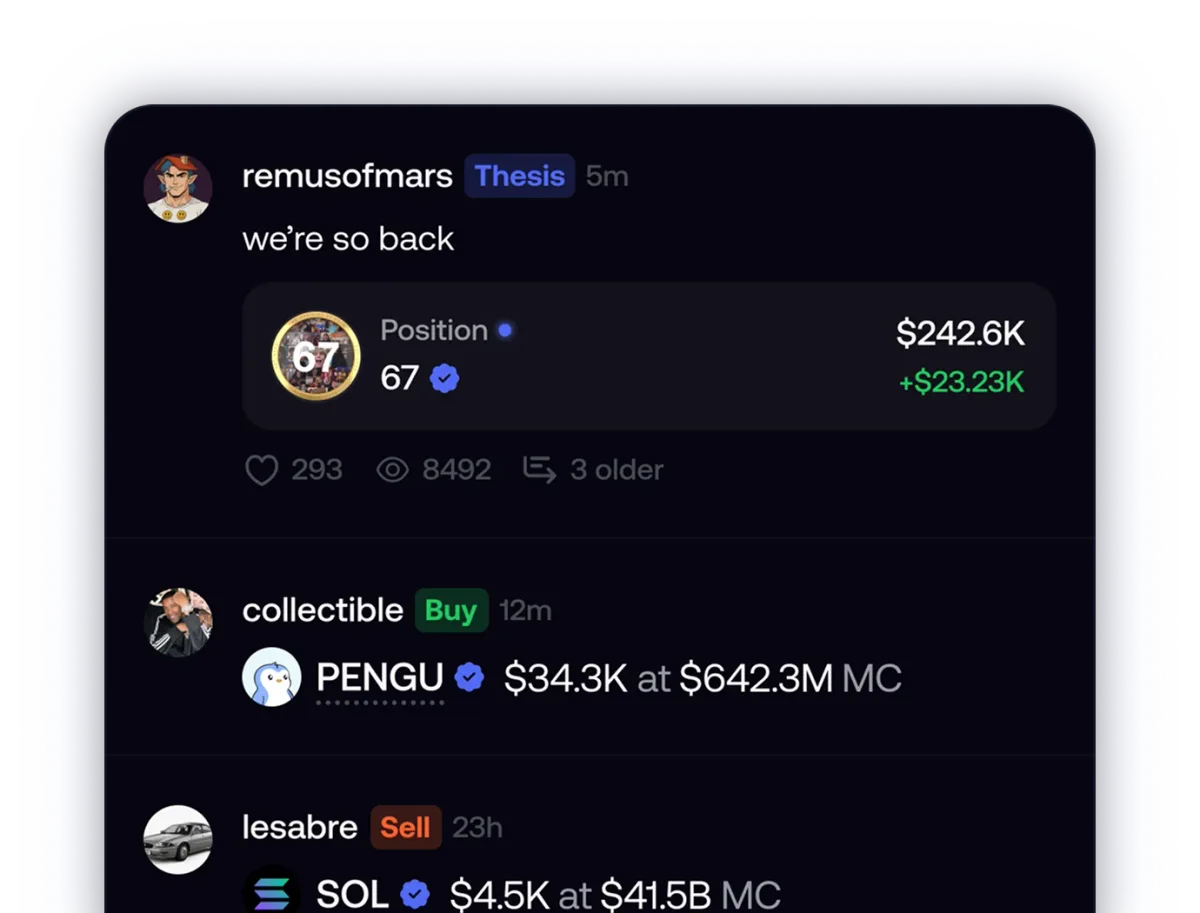
fomo also lists six blockchains against Moonshot's two, plus a social feed and access to perpetual futures. Moonshot's case is a simpler app with bank transfer funding. On price, using both apps' own numbers as published on those dates, fomo wins.
fomo and Moonshot solve the same problem the same way: buy crypto from your phone with a card or Apple Pay, no exchange account required. They get compared constantly because they're each other's closest competitor on that exact pitch.
Here's what differs, with the fee numbers pulled from each app's published terms.
Source: fomo, official product image
On both apps' published fees as of 2026-08-20, fomo is the cheaper one at every size in the table below, and the gap widens once fomo's percentage rate takes over at 190 USDC. Moonshot's case is simplicity and bank funding. Both apps price small trades on something other than their headline rate, which is the thing to check before either percentage.
What does fomo charge against Moonshot?
| fomo | Moonshot | |
|---|---|---|
| Spot fee | 0.50% (0.05% on select major tokens), Solana banded by order size: flat 0.10 USDC under 5, 2% to 47.50, flat 0.95 USDC to 190, then 0.50% | 2.5% under $100, 1% over $100, about $0.99 minimum |
| Chains | Solana, Base, BNB Chain, Monad, Ethereum, Robinhood Chain | Solana, Base |
| Referral discount | 10% off trading fees, 0.50% to 0.45%, per fomo's help center | None found in the pages we checked |
| Social feed | Yes, follow traders and see their trades | None found in the pages we checked |
| Perpetual futures | Yes, routed to independent third-party protocols per fomo's terms | Not documented in the pages we checked |
| Funding | Card, Apple Pay, USDC transfer | Card, Apple Pay, bank transfer |
| Wallet | Key split into shares across parties via Privy, per fomo's help center | Moonshot documents its own wallet setup; we have not verified its key-management details |
Sources: fomo fees and referral terms from help.fomo.family; Moonshot fees from support.moonshot.com; fomo's sixth chain, Robinhood Chain, from fomo's own announcement dated 2026-07-09. Both fee pages were checked 2026-08-20. The chain and feature rows were read earlier and have not moved since: fomo's 2026-08-14, Moonshot's 2026-08-08. Where a cell says we found nothing, that means nothing in the pages we read, not that the feature doesn't exist.
We take neither app's marketing figure at face value, and how we source these figures sets out the rule we apply when an app's terms and its help center disagree, which on fomo's fees they do.
At what trade size does fomo become cheaper than Moonshot?
fomo's headline fee (0.50%) looks worse than Moonshot's only if you ignore both minimums. Run the math on the published rates:
| Trade size | fomo fee | Moonshot fee |
|---|---|---|
| $10 | $0.20 (2.0%) | $0.99 (9.9%) |
| $25 | $0.50 (2.0%) | $0.99 (4.0%) |
| $50 | $0.95 (1.9%) | $1.25 (2.5%) |
| $100 | $0.95 (0.95%) | $1.00 (1.0%) |
| $500 | $2.50 (0.50%) | $5.00 (1.0%) |
Every dollar figure in the table above is our own arithmetic over each company's published rate, not a number either company quotes. How we source figures sets out the rule we apply, including what we do when an app's own documents disagree.
Our calculations, from the published rates in the table above: help.fomo.family and support.moonshot.com, both checked 2026-08-20. fomo writes each flat band as "no more than" the amount shown, so the fomo column prices the worst documented case at each size.
Neither app charged us these amounts in a test, and neither figure includes anything your card issuer may add.
One caveat on the fomo column, and it is about freshness rather than accuracy. This is the third Solana schedule fomo has published this month: a $0.95 minimum below 200 USDC on 8 August, a minimum of no more than 0.50 USDC below 100 USDC on 14 August, and the bands above on 20 August. Its Terms of Use used to state a fourth figure again, and were rewritten on 17 August to state none at all outside perps, so the help center is now the only place fomo publishes a schedule.
Moonshot's page has not moved across the same period. A comparison of two published schedules is only as current as its most recently changed side, and on this one that is fomo's. fomo Fees Explained tracks the whole history.
The pattern in both columns is the same at the bottom: what you actually pay on a small trade has little to do with the headline rate.
At 190 USDC fomo's percentage fee takes over from its last flat band at exactly the same 0.95, so its effective rate stops falling there, while Moonshot's better published tier stays at 1%.
The cheapest move on either app
Trade less often, in bigger amounts. On fomo's published rates (help.fomo.family, checked 2026-08-20), a single $200 trade costs $1.00, while ten separate $20 trades cost $4.00 in the 2% band for the same total exposure.
Where fomo comes out ahead
The social feed. Seeing what traders you follow are buying is the reason most people compare these two apps at all. We found nothing equivalent in Moonshot's published material when we read it on 2026-08-08. The profit ranking that feeds it is fomo's real differentiator, and how that leaderboard works is worth reading before you weigh it as an advantage.
More chains. Six against two on each app's published list, fomo's read 2026-08-14 and Moonshot's read 2026-08-08. If you want BNB Chain, Monad, Ethereum, or Robinhood Chain tokens from the same app, fomo's list covers them and Moonshot's doesn't.
Cheaper at every size we priced. At the sizes in the table above, using fomo's rates and Moonshot's, both read 2026-08-20, fomo costs less at $10 and it costs half as much at $500, where its 0.50% rate meets Moonshot's 1% tier. That holds while both schedules stay as published.
A documented referral discount. fomo's help center, read 2026-08-14, documents a 10% cut in trading fees for referred users, taking 0.50% to 0.45%, with the code enterable only at signup. We found no equivalent published on Moonshot's side.
Where Moonshot comes out ahead
Bank transfer funding. Moonshot's published funding options, read 2026-08-08, include a bank transfer alongside card and Apple Pay. fomo's published options are card, Apple Pay, and a crypto transfer. If you would rather not put trades on a card, that difference matters more than a few basis points.
A simpler app. No feed, no follow mechanic, just buy and sell. If you don't want a social layer in a trading app, there's less to ignore.
One published rate, no threshold to remember. Moonshot's schedule is two percentage tiers and a minimum. fomo's help center and fomo's Terms of Use currently describe its minimum fee differently from each other, as the table above notes, so working out what a small fomo trade costs means deciding which fomo document to believe.
The bigger picture: neither is the cheap option
Both apps charge a real premium against venues built for active traders, and that premium buys the phone app and the Apple Pay onboarding.
For scale, fomo's own help center puts the  Hyperliquid taker fee its perps route to at roughly 0.045%, an order of magnitude below either app's spot rate, though a perp on a dedicated venue is a different product with different risks.
Desktop trading terminals sit somewhere in between, and their tiers move often enough that we won't quote one here without a fresh check.
If you want the wider field on one page, what a trade actually costs puts fomo, Moonshot, Phantom and the router underneath them through the same four trade sizes, and our full fee breakdown covers fomo's own schedule in depth.
Trade on fomo
Sign up through our link and the 10% referral fee discount applies at signup, per fomo's referral terms.
Get the fomo appAlso see: fomo Fees Explained for the complete schedule, and our sister site HyperliquidGuide for what fomo's perps cost once you go past the builder fee.
Frequently Asked Questions
fomo, at every trade size in the table on this page, using each app's own published rates, both checked 2026-08-20: fomo's from help.fomo.family and Moonshot's from support.moonshot.com. fomo prices Solana in four bands by order size, so a $10 trade pays its 2% band and costs $0.20 against Moonshot's roughly $0.99 minimum. A $50 trade is $0.95 against $1.25. From 190 USDC up fomo's 0.50% rate applies while Moonshot's better published tier is 1%, so a $500 trade is $2.50 against $5.00. Both apps still charge more than their headline rates on small trades. Published rates change, and fomo changed its three times this month, so check both before you rely on this.
We found no follow-and-feed social layer in Moonshot's own published material when we checked on 2026-08-08. fomo's feed, where you can see what traders you follow are buying, is one of the main differences between the two apps.
fomo lists six: Solana, Base, BNB Chain, Monad, Ethereum, and Robinhood Chain, the last of which fomo announced on 2026-07-09. Moonshot's published material listed Solana and Base when we checked on 2026-08-08. Chain support gets added over time, so check each app's current documentation.
Both are built for the same starting point: pay with Apple Pay or a card, with no seed phrase to manage upfront. fomo adds a social feed on top. Moonshot keeps the experience closer to a plain buy and sell app, and lists bank transfer as a funding option alongside cards.
FomoAppGuide is an independent, unofficial resource. It is not affiliated with, produced by, reviewed by, endorsed by, or sponsored by FOMO Labs, Inc., the company behind the fomo app. "fomo" and all related names, logos, and marks belong to their respective owners and are used here only to identify and comment on the products this site covers. For anything official, go to fomo.family. Full disclaimer.
Disclaimer: Nothing here is legal, tax, financial, or investment advice, and none of it is a recommendation to trade. Trading crypto carries real risk of total loss. Whether a product is lawful, how a trade is taxed, and what is available where all vary by jurisdiction and change over time. Check the primary sources, read the platform's own terms, and speak to a qualified professional before acting on anything you read on this site. Trading memecoins in particular involves substantial risk of loss, and most of them go to zero. Past performance is not indicative of future results. This site contains referral links: signing up through our referral link earns us a share of the trading fee you pay, at no extra cost to you, and gives you a permanent 10% discount on your own trading fee.
Ready to Start Trading?
Sign up to fomo through our link and your trading fee is permanently 0.45% instead of 0.50%.
Get 10% off fomo fees